

|
Getting your Trinity Audio player ready...
|
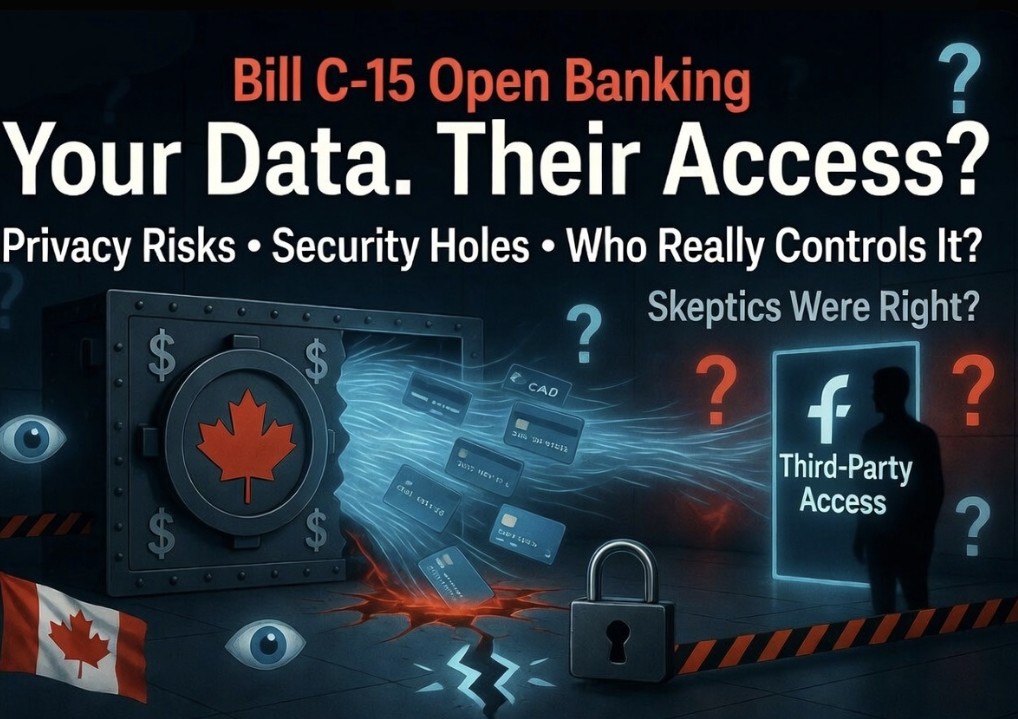
Well folks, buckle up because Bill C-15, the Consumer-Driven Banking Act, the Canadian government legalized sharing your financial data with third-party apps, spearheaded by Chrystia Freeland and original architects Colleen Johnston and François Lafortune, this law is marketed as liberation but functions as a blueprint for mass corporate surveillance.
This framework is a corporate gold mine that turns your intimate financial habits into a permanent commodity. Corporations use “consent fatigue” to win, bombarding you with manipulative designs until you surrender your privacy just to stop the pop-ups. It trades a lifetime of security for a moment of convenience.
Every app you connect shatters the safety of the “Big Bank” vault, creating new doors for hackers and spreading your history across hungrier, less-secure companies. When the data spills, you alone suffer the identity theft. Meanwhile, companies use this data for digital redlining, cherry-picking the rich while targeting the struggling with predatory loans and automated blackballing.
The “Right to Delete” is a myth because algorithms digest your behavior instantly, keeping your financial DNA in their models forever. The rollout is already underway: “read-only” access launches in early 2026, with full “write access” following in mid-2027, allowing corporations to both watch and move your money. Canada is opening the gates and you are the product.
How to Protect Yourself
At your bank branch, add a Trusted Contact Person so the bank can quickly reach someone you trust if suspicious activity arises. Explicitly disable high-risk features you rarely use such as contactless tap, Interac e-Transfers, quick-pay options, or overdraft protection to shrink your exposure. Finally, request a security note on your file requiring phone or in-branch verification for any large transfers or unusual activity. These quick steps keep you in control even if open banking data sharing goes wrong.
DGB

Usefull Links:
Gig Worker or Self Employed Needs This
